Accurate SE Tax Calculation
Models Social Security, Medicare, the wage base cap, and the self-employment tax deduction instead of using a rough flat percentage.

2026 freelancer tax planning
MyTaxQuarter helps US freelancers, consultants, creators, and 1099 contractors estimate quarterly estimated tax payments using 2026 federal brackets, self-employment tax rules, state tax assumptions, and safe harbor planning.
Use the Tax Calculator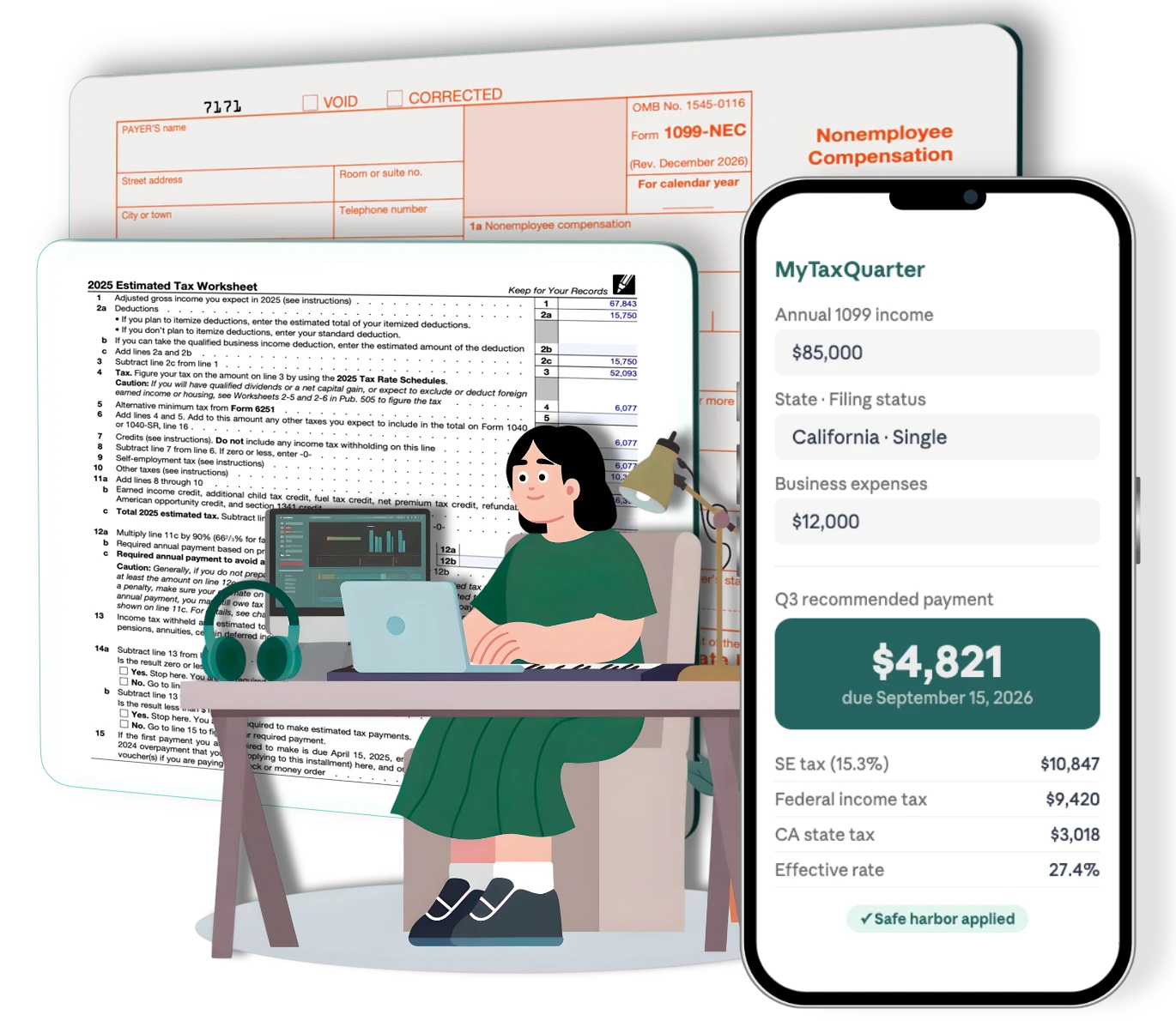
Models Social Security, Medicare, the wage base cap, and the self-employment tax deduction instead of using a rough flat percentage.
Includes detailed rates for the largest states and a conservative fallback estimate for planning when your state is not yet modeled.
Compares current-year estimates with prior-year safe harbor targets so you can plan payments with penalty rules in mind.
Work backward from your desired take-home income, taxes, expenses, benefits, and billable hours to find the hourly, daily, weekly, and monthly rates your freelance business needs.
Quick answers
Self-employment tax is the Social Security and Medicare tax paid by people who work for themselves. Employees split these payroll taxes with an employer through paycheck withholding, but freelancers, sole proprietors, independent contractors, gig workers, and many partners in partnerships generally pay both sides through self-employment tax. The tax is separate from federal income tax. You may owe income tax because your business made a profit, and you may also owe self-employment tax because that profit counts as earned income for Social Security and Medicare. For most 1099 contractors, the starting point is net profit after ordinary and necessary business expenses, not gross deposits. That means keeping accurate records matters. If your net self-employment earnings are small, special filing thresholds may apply, but anyone earning meaningful freelance income should plan for this tax throughout the year. MyTaxQuarter estimates it alongside income tax so you are not surprised at filing time.
The standard self-employment tax rate is 15.3%, made up of 12.4% for Social Security and 2.9% for Medicare. The important detail is that the full 15.3% does not apply to unlimited income. The Social Security portion applies only up to the annual wage base, while the Medicare portion continues beyond that amount. Higher earners may also owe the 0.9% Additional Medicare Tax above the filing-status threshold. Self-employed people also generally calculate the tax on 92.35% of net earnings from self-employment, and they can deduct the employer-equivalent portion of self-employment tax as an adjustment when calculating income tax. This deduction reduces income tax, but it does not erase the self-employment tax itself. MyTaxQuarter models the Social Security cap, Medicare portion, Additional Medicare Tax threshold, and self-employment tax deduction so the estimate is more realistic than a simple flat percentage.
For the 2026 tax year, the federal estimated tax deadlines are April 15, 2026 for first-quarter income, June 16, 2026 for second-quarter income, September 15, 2026 for third-quarter income, and January 15, 2027 for fourth-quarter income. These deadlines are uneven because the IRS estimated tax calendar does not divide the year into four equal three-month periods. The second payment covers April and May only, while the third payment covers June through August. If a deadline falls on a weekend or legal holiday, the due date can shift. Taxpayers outside the United States, people affected by federally declared disasters, and certain fiscal-year taxpayers may have different rules. State estimated tax deadlines often follow the federal pattern, but not always. Use the schedule as a planning baseline, then confirm the exact deadline with the IRS and your state tax agency before sending a payment.
Missing a quarterly estimated tax payment does not usually mean you have failed to file a tax return, but it can create an underpayment penalty. The IRS generally looks at whether enough tax was paid by each required installment date, not only whether the full amount was paid by April. If you miss a payment, paying as soon as possible can reduce the amount of time the underpayment is outstanding. You may still owe a penalty or interest-like charge, but the amount is typically smaller when the delay is shorter. If your income was uneven, you may be able to use the annualized income installment method to show that a lower earlier payment was reasonable because you had not earned the income yet. State agencies may impose their own penalties. A missed payment is a signal to update your estimate, pay what you can, and keep records showing when income was earned.
The safe harbor rule is a penalty-avoidance target for estimated taxes. Instead of perfectly predicting this year's final tax bill, many taxpayers can avoid federal underpayment penalties by paying enough during the year based on last year's tax. The common safe harbor is 100% of prior-year total tax, or 110% if prior-year adjusted gross income was more than $150,000 for many filers. Safe harbor does not mean you will owe nothing at tax time. It means you may avoid the underpayment penalty even if your current-year income grows and your final balance is higher than the payments you made. The rule works best when last year's return covered a full 12 months and you filed it correctly. MyTaxQuarter compares a safe harbor target with a current-year annualized estimate and recommends the lower planning target, which helps balance cash flow with penalty protection.
Variable income is common for freelancers, and it makes quarterly planning harder. A designer might have one large project in March, no income in April, and several invoices paid in August. One approach is to estimate annual income from year-to-date profit and update the calculation every month. Another is to use the annualized income installment method, which matches payments more closely to when income is actually earned. This can be useful if most income arrives late in the year because it may show that smaller earlier payments were reasonable. The key is to track net profit by date, not just total bank deposits. Record income, deductible expenses, estimated payments, and any tax withheld from W-2 work. MyTaxQuarter includes an annualized income input so you can model your current pace instead of guessing the whole year once in January.